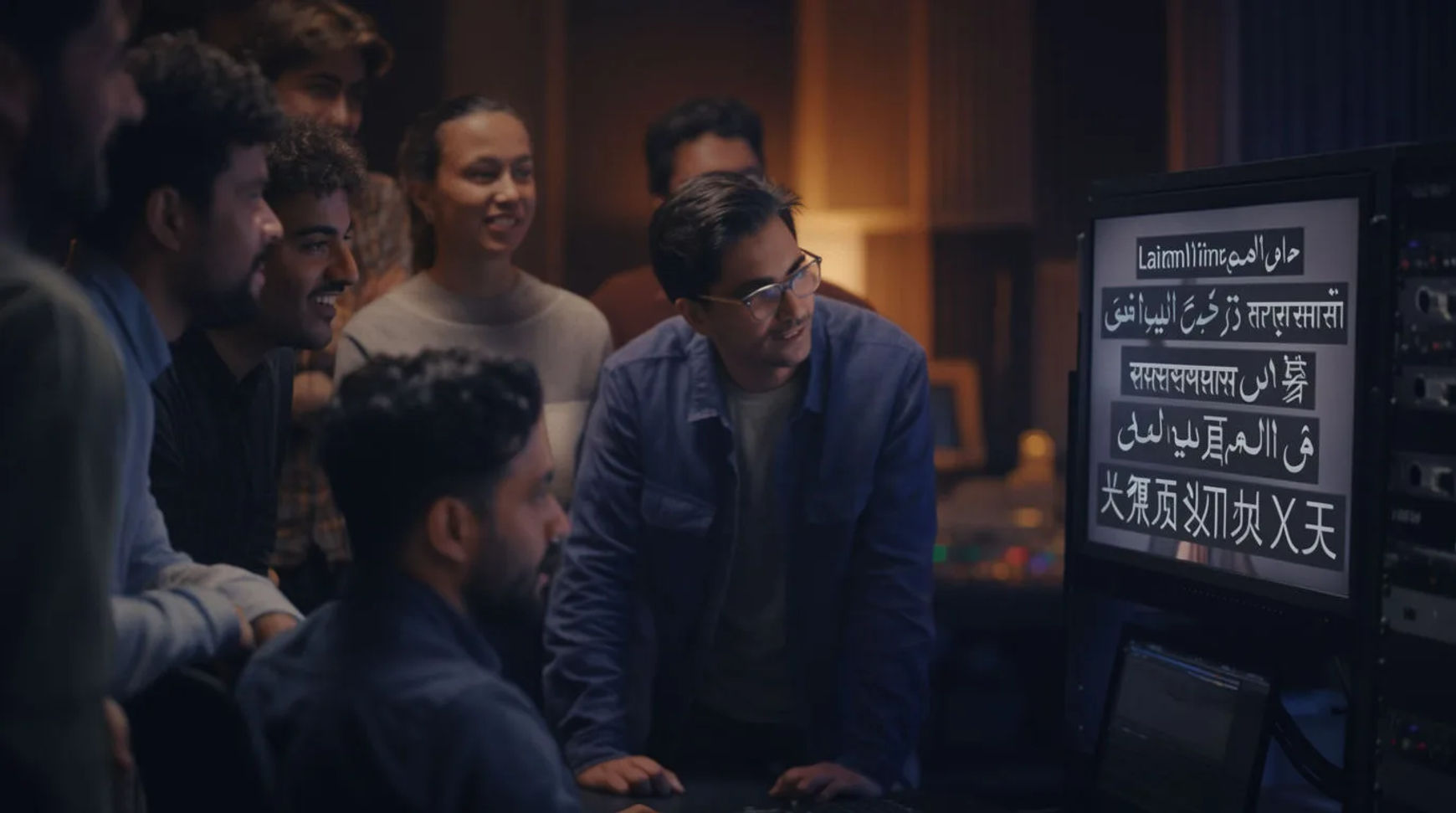
Regional and vernacular OTT platforms localize trailers and promos by starting from one master, transcribing and translating its audio, regenerating the voice in each target language, then subtitling and exporting a version per market, all in one place. The workflow is short: start from the master, transcribe and translate, regenerate the voice per language, then subtitle and export. Because every step lives in the same project, a title that ships into a dozen languages becomes a set of translate-and-regenerate passes rather than a dozen separate dubs, and the visuals stay the master's visuals throughout.
Steps at a glance
- Start from the master promo
- Transcribe and translate the audio
- Regenerate the voice per language
- Subtitle and export per market
- Hold the visuals steady across every version
How a regional OTT team localizes a promo, step by step
Start from the master promo
Lock the master trailer or promo first: the visuals, the pacing, and the title treatment that every market will share. This is the version you localize outward from, so it is worth getting right before you branch. Keeping one master rather than editing each language from scratch is what stops a dozen markets from drifting into a dozen slightly different films.
Transcribe and translate the audio
Transcribe the master's audio, which auto-detects the source language, then translate the transcript into each target language for the market. The transcript becomes the script for both the localized voiceover and the subtitles, so the translation is done once and feeds both. This is where a human reviewer checks that the wording lands in the market rather than reading as a literal rendering.
Regenerate the voice per language
Generate a directed voiceover in each target language, choosing tone and pacing so the read sounds native to the market rather than flat. This is localized performance, a voice generated in the new language, not a clone of the original narrator. A promo that felt right in the source language is re-voiced per market without re-recording a single line, and the visuals never change.
Subtitle and export per market
Style the translated subtitles to the brand, font, weight, color, and position, and burn them onto the cut, with word-level timing where a market reads captions on muted feeds. Then export a version per market from the same project. A paid plan exports at higher resolution for customer-facing surfaces, and a finished cut can be exported to higher resolution to meet a delivery spec.
Here are a few of the finished versions this produces, each localized from one master rather than reshot:
Master promo
Subtitled cut
Re-voiced version
Per-market reshoot or dub versus AI localization
The change is less about any single language and more about how localizing a whole catalog shifts when every version comes off one master. Here is the shift, honestly drawn.
| Stage | Reshoot or dub | AI localization |
|---|---|---|
| The script | A translation vendor | Translate the transcript |
| The voice | A dubbing session | A directed voice per language |
| Subtitles | A separate captioner | Styled from the translation |
| Adding a market | A new production | Another pass on the master |
| Best used for | A flagship dub | A whole vernacular catalog |
Put it together
Localizing at scale is not about re-producing a promo in every language; it is about branching one master into every market with translated voice and subtitles while the visuals stay put. Start from the master, transcribe and translate once, regenerate the voice per language, then subtitle and export per market in the same place. The value that matters is how cheaply a new market becomes another pass rather than another production. The lowest-risk way to feel it is to localize one recent promo into two languages and compare the cost honestly. The subtitle translator handles the translated captions, and how to add AI voiceover to a video covers directing the localized read so it lands like a native promo.