1940s radio announcer AI voices
Try MorphicBrowse AI 1940s radio announcer voices, from a clipped newsreader to a grand wartime host, build one in the generator, then lip sync the read to a face on screen.
1940s radio announcer voices for radio dramas, newsreels, and wartime broadcasts
Ellsworth
A crisp, brisk 1940s announcer voice, authoritative and clipped for an evening news bulletin
Maude
A poised, steady 1940s announcer voice, warm and reassuring for a home-front program host
Harlan
A grand, sweeping 1940s announcer voice, stirring and stately for a wartime broadcast address
Dottie
A peppy, bright 1940s announcer voice, lively and quick for a music and variety show host
Roscoe
A grounded, urgent 1940s announcer voice, sober and immediate for a remote field report
Cleo
A smooth, polished 1940s announcer voice, inviting and bright for the sponsor and bond-drive reads
Design your 1940s radio announcer voice
Mix and match the traits below. Your prompt builds as you go.
A bottomless, gravelly, menacing overlord 1940s radio announcer voice
GenerateTurn a 1940s radio announcer voice into a talking character
Most voice tools stop at an audio file. Morphic maps the bulletin onto a face so an announcer at a period microphone speaks every line on screen, mouth and timing matched by lip sync, taking you from a typed script to a talking 1940s radio announcer clip.
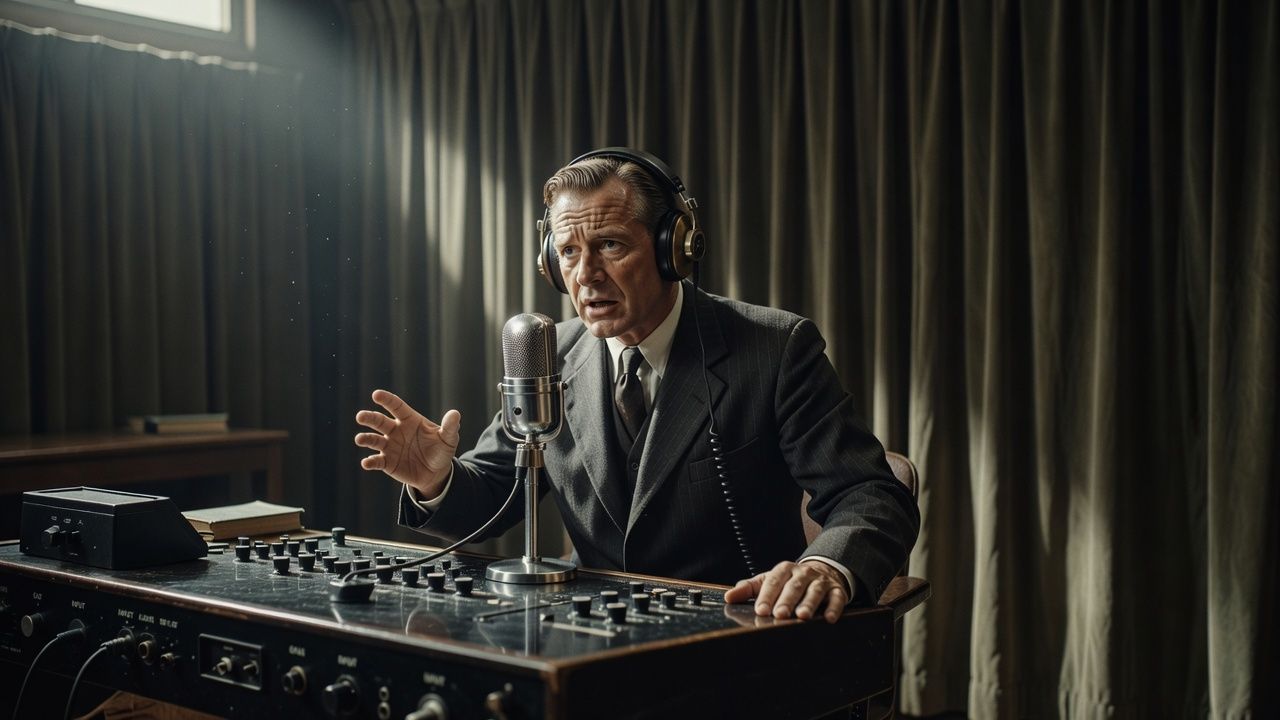
Golden-age voices for radio dramas, newsreels, and wartime broadcasts
Cast the whole golden-age lineup. Browse voices from a clipped newsreader to a grand wartime presenter, each directed from a prompt and ready to carry an evening bulletin, a serial drama interlude, or a stirring home-front broadcast in period style.

1940s radio announcer voice text to speech for bulletins and serials
Paste a script and turn it into a finished broadcast in seconds, no recording booth. Morphic converts your pages into a brisk, period read for news bulletins, drama serials, and museum exhibits, with diction and urgency you direct in plain English.

A 1940s radio announcer voice generator you direct in plain English
Describe the broadcaster you want, name the clip, the transatlantic polish, and the wartime gravity, and the generator builds the read. Re-voice the same bulletin as a different golden-age announcer anytime by editing the prompt, a whole broadcast roster from one workspace.

More voice styles
Simple pricing
Get started for free today, with the option to upgrade or cancel anytime.
Basic
2400 monthly credits
1 user only
All models
Workflows
Standard
3625 monthly credits
1 user only
All models
Workflows
Pro
6350 shared monthly credits
1 user
All models
Workflows
Max
24650 shared monthly credits
1 user
All models
Workflows
Enterprise
For higher limits
Custom
pricing and billing terms

Free
For playing around
$0
forever free