Screenplay basics
How to read a screenplay. What each line does, what INT., EXT., EST. and I/E mean in a scene heading, and the common abbreviations.
A screenplay follows a fixed layout, so everyone on a production reads it the same way. Morphic does the formatting; this page explains what each part means.
A scene, line by line
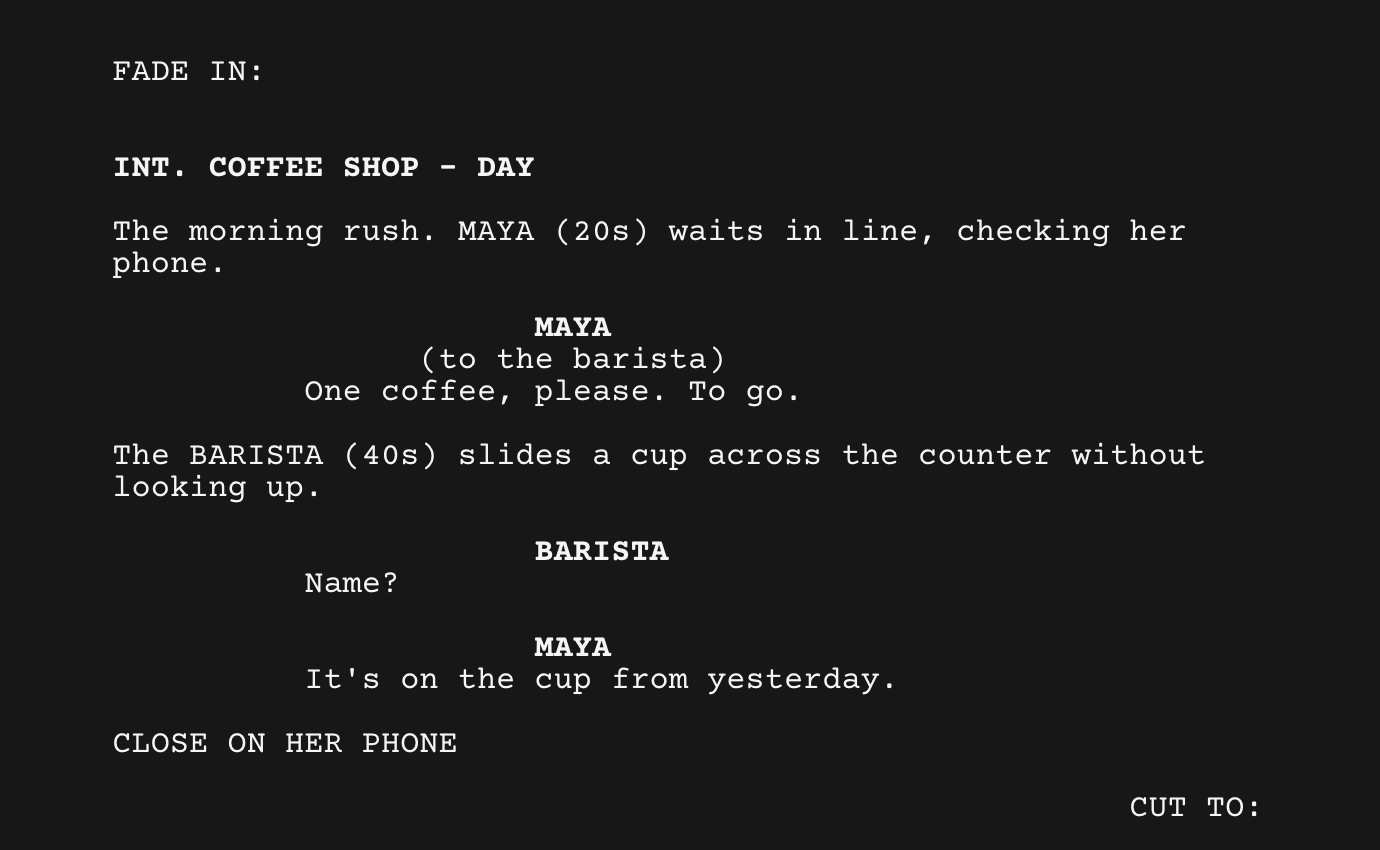
INT. COFFEE SHOP - DAY                  <- Scene heading

The morning rush. MAYA (20s) waits      <- Action
in line, checking her phone.

               MAYA                     <- Character
           (to the barista)             <- Parenthetical
     One coffee, please. To go.         <- Dialogue

CLOSE ON HER PHONE                      <- Shot

                            CUT TO:     <- Transition
The same scene in the Morphic screenplay editor, with a few more lines:
Scene headings
A scene heading starts with a code, then the place, then a dash and the time.
| Code | Meaning |
|---|---|
| INT. | Interior: the scene is inside |
| EXT. | Exterior: the scene is outside |
| I/E | Moves between inside and outside, such as a moving car |
| EST. | Establishing shot: a wide view that shows where we are |
The time is usually DAY or NIGHT. CONTINUOUS means the scene follows straight on from the last one; LATER means the same place, some time on.
Abbreviations
| You see | Meaning |
|---|---|
| (V.O.) after a name | Voice-over: heard but not spoken in the scene, such as narration |
| (O.S.) after a name | Off-screen: the character is in the scene but out of shot |
| (CONT'D) after a name | The same character keeps talking after an action line |
| (MORE) | The speech carries on to the next page |
| (beat) | A short pause in the dialogue |
| FADE IN: / FADE OUT. | The start and end of the film or episode |
| CUT TO: | A straight cut to the next scene |
| ANGLE ON, CLOSE ON | A shot: points the camera at one thing |
The PDF export adds (MORE) and (CONT'D) at page breaks, so you don't type those.
Rules of thumb
- Write only what the camera sees and hears, in the present tense
- Put a name in capitals the first time a character appears, with their age if it matters: MAYA (20s)
- Keep each action paragraph to three or four lines
- One page is about one minute of screen time
Key terms
| Term | Meaning |
|---|---|
| Screenplay format | The standard layout for scripts: a typewriter font, each line type in a fixed place, about one page per minute of screen time |
| Scene number | Each scene's number, used to plan the shoot |
| Title page | The cover page: title, writer, draft date and contact |
| Fountain (.fountain) | A screenplay saved as plain text. Simple rules mark each line, such as INT. for a heading or a name in capitals for a character, so any text editor can open it and screenplay apps show it fully formatted |
| Final Draft (.fdx) | The file format of Final Draft, the screenplay app most film and TV productions use |
That's how a screenplay reads. To start one on Morphic, see Write a screenplay.
If you have any trouble or have any questions, feel free to reach out. We're happy to help. Write to us at support@morphic.com.
Senaryo
Canvas'ta görsellerinizin, videolarınızın ve Copilot'un yanında, başlık sayfası ve bölüm başına bir doc ile biçimlendirilmiş bir senaryo yazın, içe ve dışa aktarın.
Senaryo yazma
Satırların kendilerini nasıl biçimlendirdiği, her satır türü için tuşlar ve kısayollar, metin ve blok stilleri, sayfalar ve sayfa sonları, senaryo ve doc başlık sayfaları ve adlandırma.