AI microdrama studio vs in-house: which should you run?
Updated October 2026
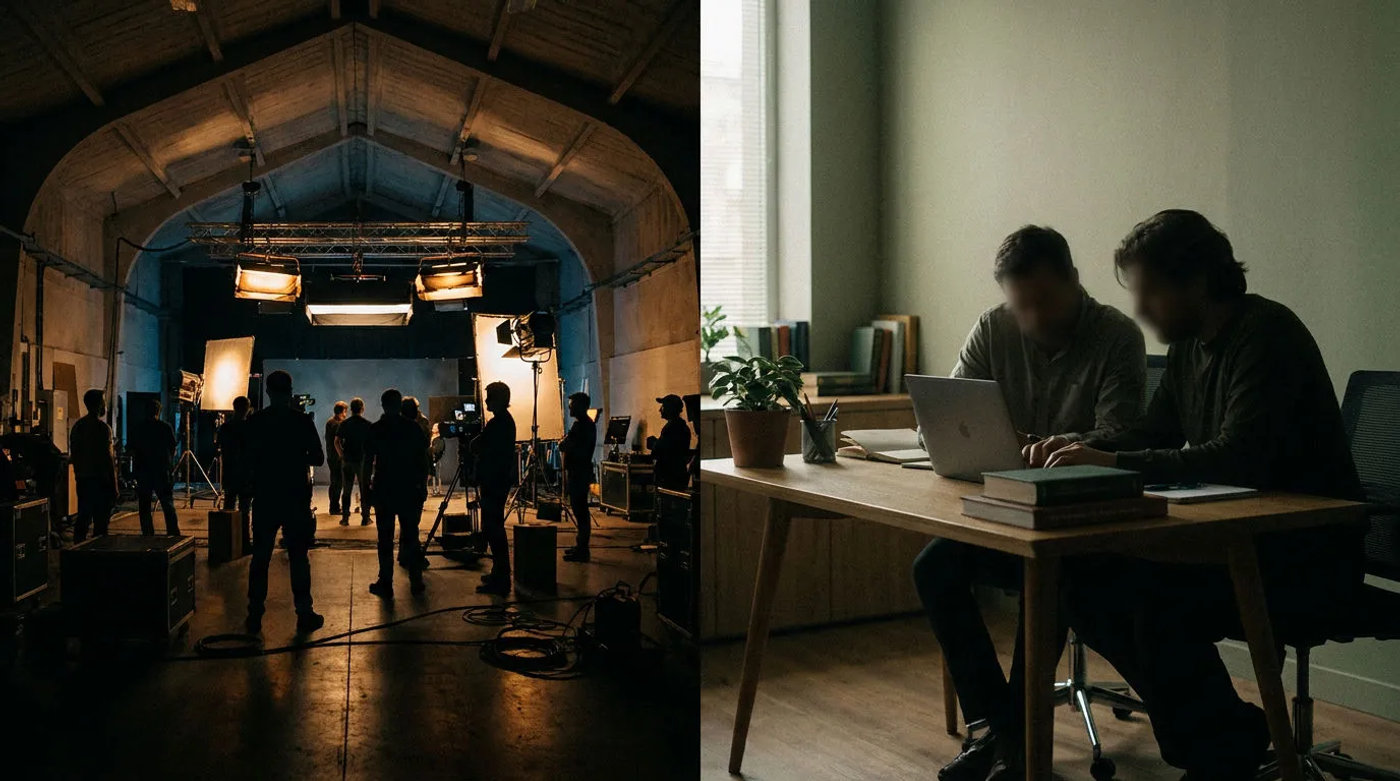
An AI microdrama studio is the fastest hand-off: you brief, they deliver, and you pay a premium per finished minute for that convenience and for someone else owning the pipeline. Freelancers cost less per hour but you coordinate every specialist and the look drifts between them. Running it in-house on a platform is the lowest marginal cost once a season is set up, and it keeps the script, the cast references and the footage in one place, but a small team still has to run it. The right call is about how much of the pipeline you want to own.
AI studio vs freelancers vs in-house at a glance
| AI studio | Freelancers | In-house on MorphicOur pick | |
|---|---|---|---|
| Cost model | Per finished minute or per episode | Hourly or day rate per specialist | Platform plan plus a small team |
| Speed to a season | Fastest to hand off, waits on their queue | Depends on who you can book | Fast once a per-episode workflow is set |
| Creative control | Via rounds of notes | Direct, but split across people | Direct, shot by shot in one workspace |
| Consistency | The studio's internal process | Varies between freelancers | Saved character and location reference sheets |
| Revisions | Billed as change rounds | Re-book the person | Re-generate or re-cut yourself |
| IP and assets | Set by the contract | Set by the contract | Scripts, references and footage stay in your workspace |
| Scale to 60 episodes | Scales with budget | Scales with people and coordination | Duplicate a saved Workflow per episode |
| Localization | Usually a separate line item | A separate specialist | Dub and lip sync in the same workspace |
| Who you need | A producer to brief and approve | A producer plus each craft hire | A writer and a producer-operator |
| Best for | Teams buying a turnkey season | One-off craft you lack in-house | Owning the pipeline across many episodes |
Or run it in-house: one workspace for the whole season
An AI studio and a roster of freelancers both put the pipeline outside your building. If you would rather own it, and keep the per-episode cost low across a long season, that is a different job.
Morphic is a browser-based workspace where a small team can run a microdrama season end to end. Copilot reads your script and generates footage against saved character and location reference sheets, so the cast and the sets stay consistent episode to episode. Compose, a real multi-track timeline in the same tab, cuts and grades the result and lays in generated voiceover, music and effects, and a per-episode sequence saved as a Workflow is duplicated and re-run for the next episode. Dubbing and lip sync localize an episode into another market without remaking it. A showrunner still owns the story, quality control still needs a human eye, and non-English speech is worth testing on a scene before a whole season, but for owning the pipeline across sixty episodes it does the job neither outsourcing route is built for.


J’ai posé cinq plans sur la timeline, dans l’ordre, avec leur audio lié. Souhaitez-vous modifier le montage ?
How they compare, in detail
Cost
A studio charges a premium per minute; freelancers are cheaper per hour but you pay in coordination; in-house is lowest once set up.
bundles generation, editing, colour, voice and dubbing into one plan, so the marginal cost of episode 60 is close to episode two.
Speed
A studio is quickest to hand off but sits in their queue; freelancers wait on availability; in-house moves as fast as your team can brief.
drafts a shot cheaply at preview resolution and renders only the keeper at full res, so iteration does not wait on anyone.
Creative control
A studio takes notes; freelancers give direct but fragmented control; in-house keeps every decision in one place.
reads your script in Copilot and generates against your own reference sheets, so the note and the fix happen in the same tab.
IP and ownership
Ownership of outsourced work is only ever what the contract assigns; running it yourself keeps the assets in your own account from the start.
keeps your scripts, saved references and generated footage inside your own workspace, yours to export at any point.
Scale
A season of 60 scales with budget at a studio, with people for freelancers, and with a repeatable workflow in-house.
saves a per-episode sequence as a Workflow you duplicate, swap inputs into and run, so episode 40 is the same process as episode four.
Team and skills
A studio needs a producer to brief; freelancers need a producer plus each specialist; in-house can run on a writer and an operator.
briefs like a teammate: describe the episode and Copilot generates, cuts and assembles, so two people can run a season.
Which model should you choose?
Three ways to make a season, each with a different thing it is best at.
| If you need | Pick | Why |
|---|---|---|
| A turnkey season with no pipeline to run | AI studio | You brief and approve; they own production, for a premium per minute. |
| One specialist craft you lack in-house | Freelancers | Book the exact skill for the exact shots without building a pipeline. |
| The lowest cost per episode across 60 episodes | Morphic | A repeatable in-house workflow keeps the marginal cost of each episode low. |
| Tight control of the look shot by shot | Morphic | Script, shots, cut and grade all answer to one person in one workspace. |
| Your scripts and footage to stay yours by default | Morphic | Assets live in your own workspace; outsourced ownership is only ever the contract. |
Ce que les créateurs disent de Morphic

This is a 100% AI-made film. But so well done!
This is how AI filmmaking should be done.
Very realistic and professionally written and directed by the @morphic team on their platform and without using Seedance 2.0

Morphic has been my first choice for image generation for more than 9 months now.
But it's also a great all-in-one platform that can fully support your entire creative workflow.
Highly recommend trying Morphic.

On Morphic Canvas, you can easily group and sort your files, making it a breeze to pick what you need or just grab everything at once. @morphic
Current obsession: GPT Image 2 on Morphic.
Tarifs simples
Commencez gratuitement dès aujourd'hui, avec la possibilité de mettre à niveau ou d'annuler à tout moment.
Basic
2400 mensuel crédits
1 utilisateur uniquement
Tous les modèles
Workflows
Standard
3625 mensuel crédits
1 utilisateur uniquement
Tous les modèles
Workflows
Pro
6350 partagé mensuel crédits
1 utilisateur
Tous les modèles
Workflows
Max
24650 partagé mensuel crédits
1 utilisateur
Tous les modèles
Workflows
Enterprise
Pour des limites plus élevées
Personnalisé
conditions de tarification et de facturation

Free
Pour expérimenter
$0
gratuit pour toujours