How to make Arthurian Merlin videos with AI

Arthurian Merlin is the prophet, druid, and kingmaker of the Matter of Britain: the figure who raises Stonehenge, engineers Arthur’s conception at Tintagel, plants the sword in the stone, gifts Excalibur, founds the Round Table, and finally lets himself be trapped in the wood of Brocéliande by his apprentice Vivien. He sits at the bridge between the Brittonic Celtic druidic tradition and the high-medieval Arthurian cycle.

He is one of the densest single figures in Western myth, and barely touched by modern film outside the obvious adaptations.

Arthurian Merlin is the prophet, kingmaker, and shape-shifting druid who set Arthur on the throne of Britain. He raises Stonehenge by enchantment, engineers the conception at Tintagel, plants the sword in the stone, gifts Excalibur, founds the Round Table, then takes himself off into the forest of Brocéliande for love of Vivien. Morphic lets you direct the whole arc in your browser. Pick a moment and start now.

Arthurian Merlin figures you can direct

Arthurian Merlin scenes you can stage

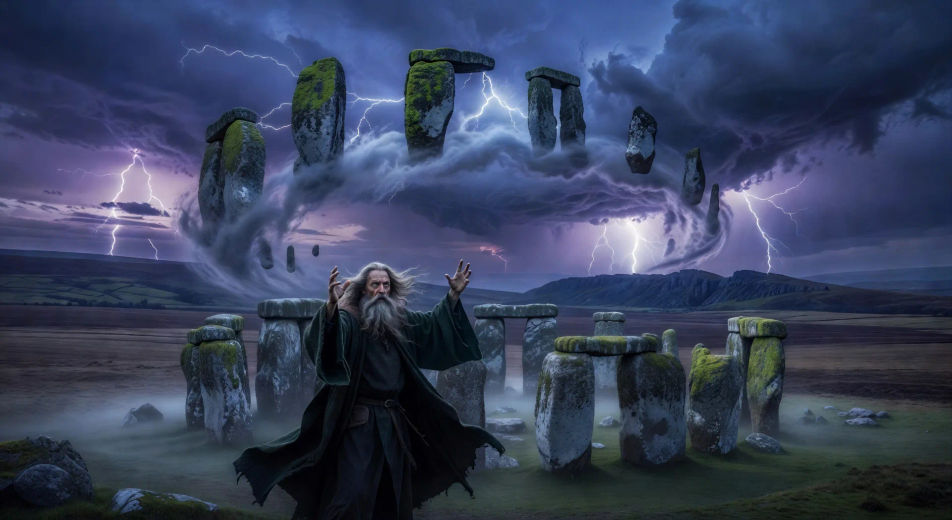
The raising of Stonehenge

Merlin standing on the empty Salisbury Plain at dusk, arms lifted, the great sarsens of Stonehenge in mid-flight from Ireland, drifting through cloud and storm-lit sky to settle into a perfect circle on the heath below.

Edit prompt
The raising of Stonehenge

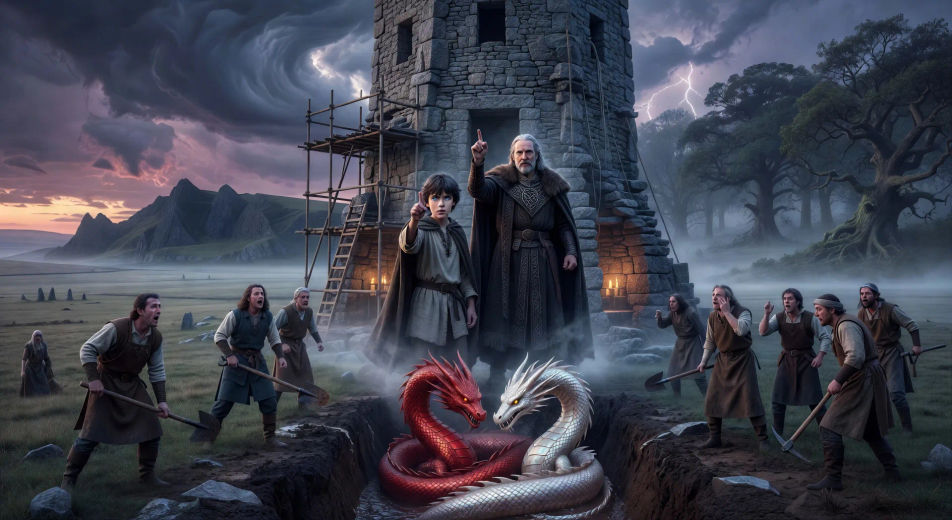
Boy at Vortigern’s tower

The boy Merlin standing in front of Vortigern at the foot of the half-built tower at dusk, finger raised, the trench at their feet exposing a glimpse of the red and white dragons coiled in the foundations. Workmen frozen in horror.

Edit prompt
Boy at Vortigern’s tower

The conception at Tintagel

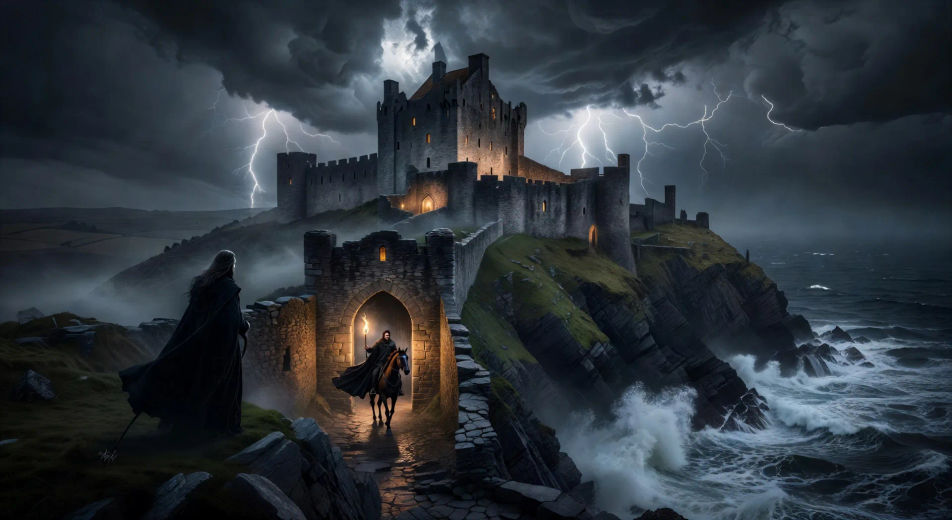
Tintagel castle on its cliffs at midnight by storm-light, Merlin in shadow on the headland watching as a torch-lit horseman in Cornish black rides through the gatehouse. Atlantic surf at the foot of the cliffs.

Edit prompt
The conception at Tintagel

Sword in the stone in the churchyard

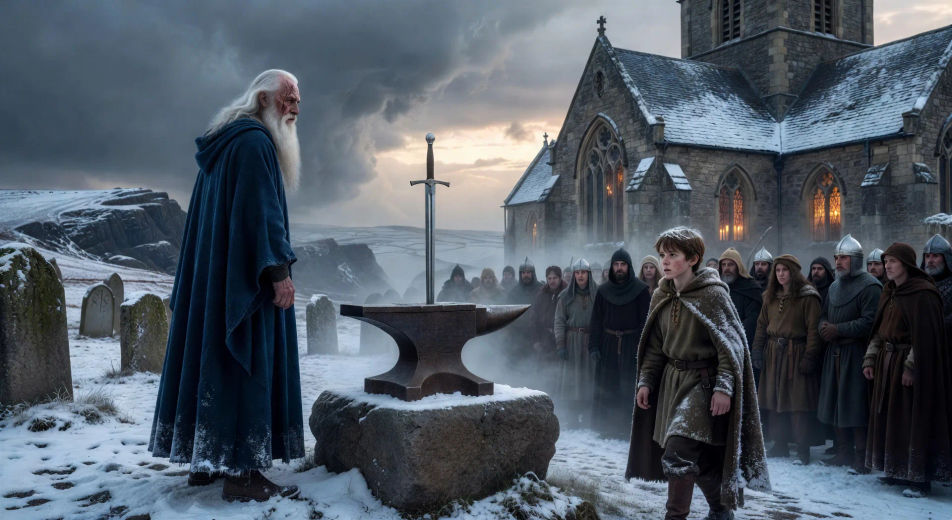
A snow-dusted London churchyard at first light on New Year’s Day. Merlin in his blue robe standing back from a flat anvil set on a great square stone, the slim sword fixed point-down through it. The boy Arthur stepping forward from the crowd.

Edit prompt
Sword in the stone in the churchyard

The gift of Excalibur

A still lake at first light, mist on the water. Merlin standing at the prow of a small boat with the boy-king Arthur, the hand of the Lady of the Lake rising from the surface offering Excalibur in white silk wrappings.

Edit prompt
The gift of Excalibur

The trap at Brocéliande

Merlin seated against the trunk of a great oak in the forest of Brocéliande at twilight, eyes closed, Vivien finishing the last figure of the binding spell with a slim hawthorn wand. The air around the oak shimmering as the trap closes.

Edit prompt
The trap at Brocéliande

Make Arthurian Merlin videos in three steps

  1. 01

    Describe your Arthurian Merlin scene

    Write the Arthurian Merlin scene you want to see in your own words. Be specific about the moment in the cycle, the source (Geoffrey, Vulgate, Tennyson), the lighting, and the camera direction. The more concrete the description, the closer the result lands to what you pictured.

  2. 02

    Generate the video

    Morphic produces a clip on your canvas in seconds.

  3. 03

    Refine your Arthurian Merlin video

    Tweak the prompt, regenerate, or remix into a longer sequence. Download or share when the shot lands.

Related workflows

A short guide to Arthurian Merlin for video creators

Merlin’s deepest roots are Welsh. The bardic tradition preserves Myrddin Wyllt ("Merlin the Wild"), a 6th-century North British prophet who lost his mind at the battle of Arfderydd and lived as a hermit in the Caledonian Forest, speaking in prophecy to the trees. Geoffrey of Monmouth fused Myrddin with the boy-prophet Ambrosius in the Historia Regum Britanniae (1136), naming him Merlinus and giving him the famous prophecies and the engineering of Stonehenge. Geoffrey’s later Vita Merlini (c. 1150) is a long Latin poem on the prophet’s wild-man years. The Vulgate Cycle (13th century) added the Tintagel conception, the sword in the stone, the founding of the Round Table, and the trap at Brocéliande.

The standard arc, in order, runs: the boy-prophet at Vortigern’s tower, where he reveals the red and white dragons sleeping under the foundations and prophesies the future of Britain; the raising of Stonehenge from Ireland by enchantment as a memorial to the British dead; the engineering of Uther’s shapeshift as Gorlois at Tintagel and the resulting conception of Arthur; the fostering of the boy at Sir Ector’s manor; the planting of the sword in the stone in a London churchyard at the New Year; the proclamation of Arthur as high king; the gift of Excalibur from the Lady of the Lake; the founding of the Round Table at Camelot; the long counsel through Arthur’s reign; the trap at Brocéliande, where Vivien (the Lady of the Lake) seals him into the air or the rock and leaves him to prophesy from inside it for as long as Britain stands.

For video, anchor each Merlin scene to a moment from the cycle and a specific source: the boy at Vortigern’s tower (Geoffrey, Historia VI.17), Stonehenge at the raising (Geoffrey, VIII.10), the candlelit Tintagel scene (Vulgate Estoire de Merlin), the sword-in-the-stone (Vulgate), the Brocéliande trap (Vulgate / Tennyson’s Idylls). Lean on the Welsh-into-medieval palette: forest greens of Brocéliande and Caledonia, slate of standing stones, blue of bardic robes, gold of the Tintagel candles, mist on stone. The more concrete the moment, the closer the output lands to the cycle.

You might also like

Frequently asked questions

Where can I make Arthurian Merlin videos with AI?
You can create Arthurian Merlin scenes directly in your browser on Morphic. Open the Text to Video tool, describe the moment from the cycle you want, and Morphic produces the clip. No installs and no specialist software needed.
What kinds of Arthurian Merlin scenes work best with AI video?
Single-shot moments from the cycle work best: the raising of Stonehenge, the boy at Vortigern’s tower, the conception at Tintagel, the sword in the stone, the gift of Excalibur, the trap at Brocéliande, the Crystal Cave. Anchor each Arthurian Merlin scene to a specific moment, location, time of day, and mood.
How do I keep my Arthurian Merlin look consistent across scenes?
Use the Character Lineup workflow to lock the look (long deep-blue robe over grey wool, oak staff, beard streaked with grey, slate eyes), then reference that character card in every prompt. Morphic preserves the robe, staff, and bearing from scene to scene so a Merlin series feels continuous across decades of in-cycle time.
How do I write a good prompt for an Arthurian Merlin scene?
Name the moment from the cycle, the location, the time of day, the lighting, and the camera direction. Lean on the Welsh-into-medieval palette: deep blue robe, slate stone, forest green, illuminated-manuscript gold, mist on still water. For example: "Merlin on Salisbury Plain at dusk raising the sarsens of Stonehenge by enchantment, storm-lit sky behind, slow low-angle push-in." The more specific your imagery, the closer the output matches your imagination.
Can I add narration and music to my Arthurian Merlin videos?
Yes. The Speech tool generates a voiceover from your script (a passage from Geoffrey of Monmouth in translation, the Vita Merlini, Tennyson’s Idylls of the King) in the voice you choose, and the Music tool produces an original medieval-Welsh-tinged soundtrack. Layer them onto your generated video to publish a complete Arthurian Merlin episode.
How do I make my Merlin videos feel medieval Arthurian, not pop-culture wizard?
Strip the pop-culture pointed-hat wizard costume out of your prompt. Arthurian Merlin is a Welsh-derived prophet-druid in a long blue or grey robe, oak staff, no pointed hat, no star-spangled cloak. Anchor on medieval Arthurian sources: illuminated manuscript depictions of Merlin (Vulgate Cycle illuminations, the Très Riches Heures), Pre-Raphaelite paintings (Burne-Jones’s "The Beguiling of Merlin"), Welsh hill-fort and forest landscapes. Ask for "based on Vulgate Cycle illuminated Merlin iconography" and avoid words like "wizard hat", "spellbook", or any modern-fantasy reference.