Why dub a short film
A short travels further when audiences can follow it without reading. A dub keeps the performances and gives them a new language: each actor is re-voiced in their own voice, and their lips move with the new words. Dub scene by scene, add subtitles per language, and finish every version in Morphic.
Short film dubbing examples
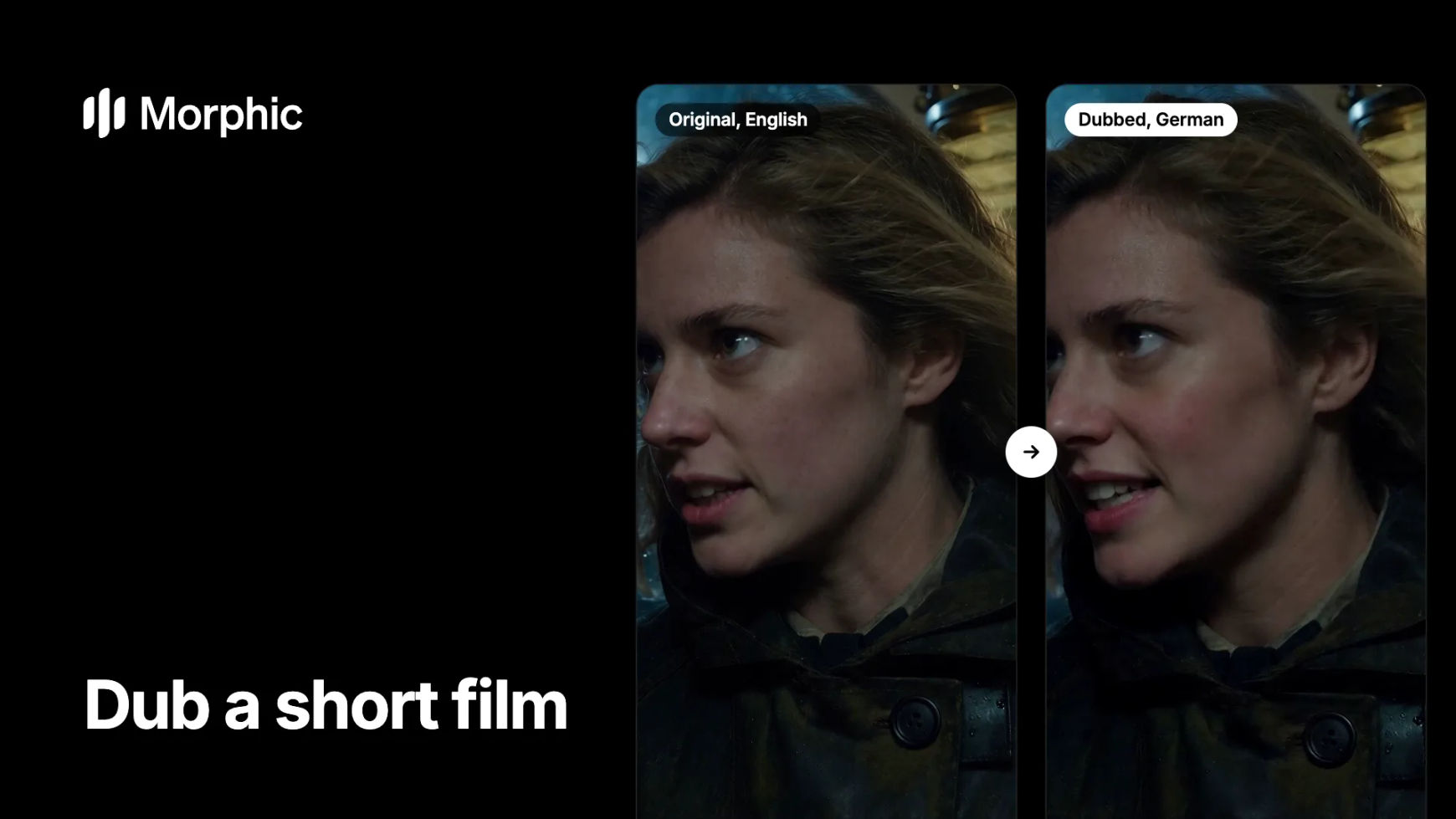
Each original scene next to its dub. Turn the sound on to hear the performance carry over.
Original, English
Dubbed, German
Her urgency survives the storm. The beam, the rain on the glass and the push-in stay as shot; only the language changes.
How to dub a short film in Morphic
Lock the cut and split it into parts
Dub from the locked edit. Each dub takes up to 10 minutes of video, so split a longer film at scene breaks in Compose. Keep a list of character names and places that must not be translated.
Dub each part with Copilot
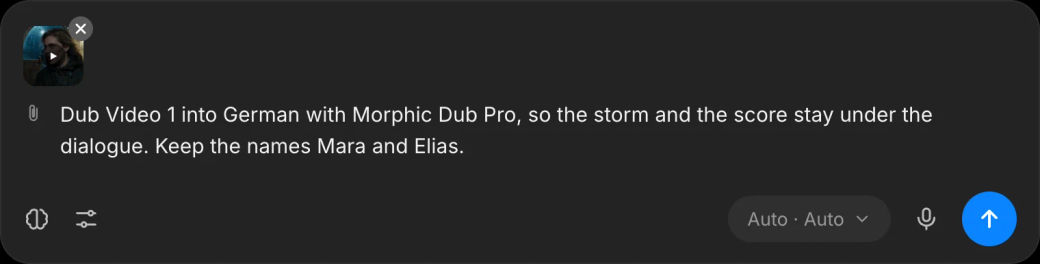
Upload a part to a Copilot chat and ask, for example, "Dub Video 1 into German with Morphic Dub Pro, keep the names Mara and Elias". Morphic Dub Pro keeps the score and ambience under the dialogue; use Morphic Dub for scenes with dialogue alone.
Rejoin the film and add subtitles
Put the dubbed parts back in order in Compose and export the full version. Ask for subtitles in the same language, so each version ships with its own subtitle file.
Dubbing a feature or a slate of films? Let's build your custom workflow.
For production companies, distributors and festival programmes. Tell us your runtime, languages and delivery dates, and we'll design a custom dubbing workflow with you, with every actor kept in their own voice across the whole film.
What a dub keeps, and what to check
What stays as shot
- The picture. Framing, camera moves, lighting and the edit are untouched.
- The performances. Each actor keeps their own voice, pace and emotion in the new language.
- The lips. They are redrawn to follow the new words, so the scene does not play as a voice-over.
What to check in each version
- Names and invented words. Listen for character and place names, and add any that changed to your request.
- On-screen text. Titles, letters and signs in the frame stay in the original language. Subtitle them or replace the shots.
- Timing of fast exchanges. Overlapping lines and quick back-and-forth are where a dub needs the closest review.
Dubbed or subtitled version?
| Version | What it gives the audience | When it fits |
|---|---|---|
| Subtitled | The original voices, with text to read | Screenings where the original language is part of the work |
| Dubbed | The performances in their own language | Platforms, broadcast and younger audiences |
| Dubbed and subtitled | Both, plus accessibility | Your main markets, and any delivery that asks for a subtitle file |
Check each festival's or platform's delivery rules before you choose: some ask for a subtitled copy, others accept dubbed versions. Still writing the film? Try the AI short film generator or browse short film ideas.
FAQs
Yes. Morphic Dub re-voices each speaker in their own voice in the new language and redraws their lips to match. The voice stays inside that dub; it is not a saved voice clone.
Up to 10 minutes per dub. Split a longer short at scene breaks, dub each part, and rejoin the parts in Compose before you export.
Morphic Dub Pro keeps the background audio under the new dialogue, so score and ambience stay in place. Ask for it on scenes where the soundtrack matters.
Morphic Dub covers 86 languages and Morphic Dub Pro covers 94, including French, German, Italian, Spanish, Japanese, Korean, Hindi and Arabic. Pro adds regional accents such as Canadian French and Mexican Spanish. Each dub is one language.
Yes. Each speaker in the clip is re-voiced in their own voice. Review scenes with overlapping lines closely, as they are the hardest to time.
Dubbing with the lips synced is on every paid plan. On the free plan Morphic dubs the audio track only.