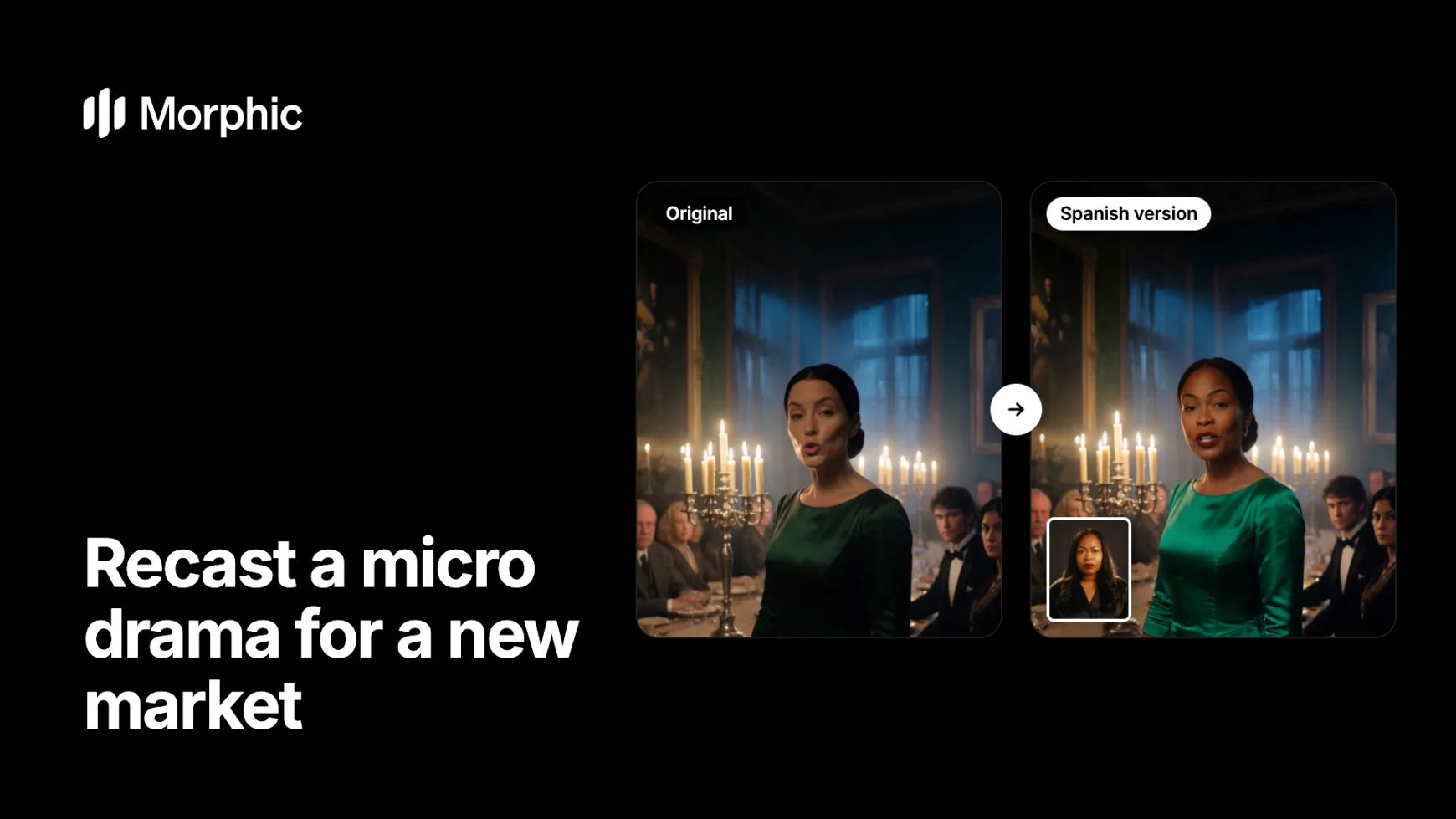
Why recast a micro drama for a new market
Subtitles alone rarely carry a series into a new country. Viewers connect faster with a lead who looks like the people around them and speaks their language. Recast the leads, dub the dialogue with the lips in sync, then add subtitles, all in Morphic, with no reshoot and no new set.
Micro drama market versions
One English scene, adapted for two markets. Turn the sound on to hear each version.
Original, English
Recast, Spanish
Recast, German
The candlelit dining room, the guests and the camera push-in stay as shot. Each version gets a new lead from one photo, then a dub that re-voices her line and syncs her lips.
How to adapt a micro drama for a new market in Morphic
Choose the leads for the market
Decide which characters change for this audience, often just the leads, and pick one clear, front-facing photo for each. Keep these photos for the whole market version so every episode shows the same faces.
Recast each shot
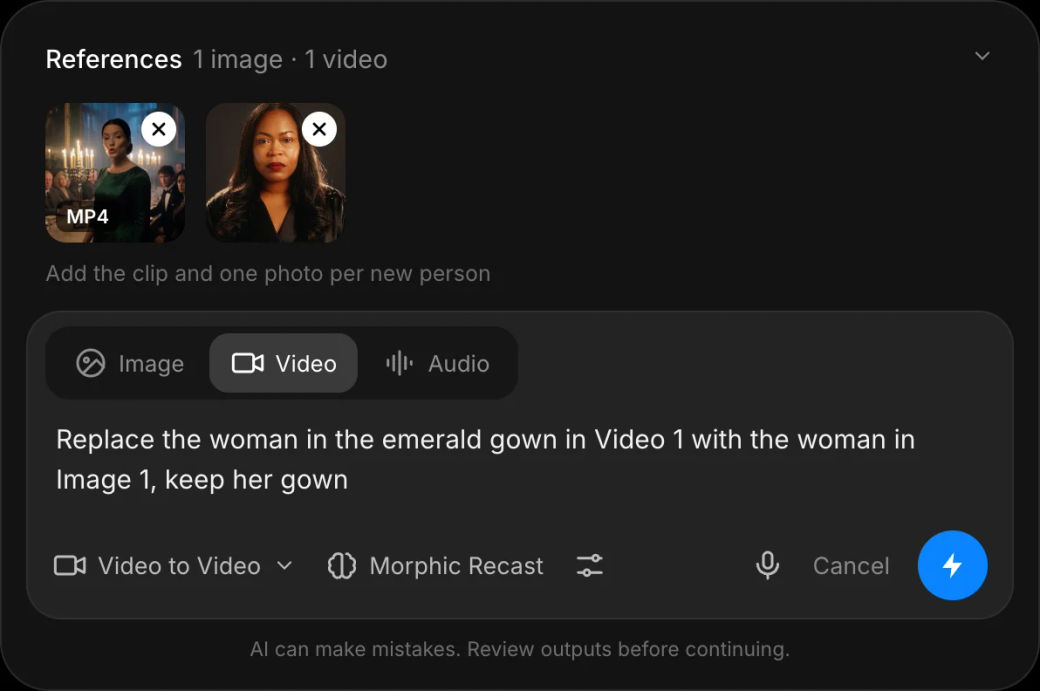
Open Morphic Recast, add a shot (up to 30 seconds) and the photos, and name the swap, for example "Replace the woman in the emerald gown in Video 1 with the woman in Image 1, keep her gown". Repeat shot by shot with the same photos.
Dub the dialogue, then add subtitles
Run the recast episode through AI dubbing: it translates the dialogue, voices it and syncs the lips to the new language. Then add subtitles in the same language for viewers who watch with the sound off.
Taking a series to new markets? Let's build your custom workflow.
For micro drama studios and platforms. Tell us which series, which markets and how many episodes, and we'll design a custom recast and dubbing workflow with you, from the first market version to the full catalogue.
What to change for a new market, and what to keep
Usually worth changing
- The leads. The faces viewers see most carry the most weight. Supporting cast and extras can often stay.
- The language. A dub with synced lips plays as if the scene was shot in that language; subtitles alone ask more of the viewer.
- On-screen text. Titles and captions should be in the market's language, so subtitle in the same pass as the dub.
Usually worth keeping
- The performances and the edit. Recast keeps the timing, the camera and the cuts, which is what made the original work.
- The story beats. Check names and references that might not travel, but the hooks and cliffhangers usually do.
Recast, dub or both?
| Approach | What changes | When it fits |
|---|---|---|
| Subtitles only | On-screen text | A quick test of a new market |
| Dubbing only | The language, with the lips synced | The cast already suits the market |
| Recast only | The people on screen | The market shares the original language |
| Recast and dub | The people and the language | A full local version of the series |
Planning several markets at once? See how to recast an ad for different markets for the same approach on a single spot, and the micro drama dubbing guide for dubbing at series scale.
FAQs
Recast the leads with photos of performers suited to the market, dub the dialogue into the market's language with the lips synced, and add subtitles. Morphic does all three in one workspace, so the series keeps its performances, camera and edit, and only the people and the language change.
Recast keeps the soundtrack as shot, so the dub starts from the original dialogue. Dubbing translates each line and voices it in the speaker's own voice in the new language, with the lips redrawn to the new words.
Recast first, then dub. The dub syncs the lips to the new language on the face that will ship, so dubbing the recast version gives the cleanest result.
A wide range, including Spanish, German, French, Portuguese, Japanese, Korean, Arabic and Hindi, one language per dub. Check the dubbing tool for the current list before you plan a market.
No. Recast only the people you name, often the leads. Anyone without a photo stays as shot, which keeps the work focused on the faces viewers see most.
Morphic Recast takes one clip of up to 30 seconds at a time. Recast an episode shot by shot, then assemble and dub the full episode.